
Maëlie Kate Jalali
Originally published in French by l’Echo on May 17, 2024
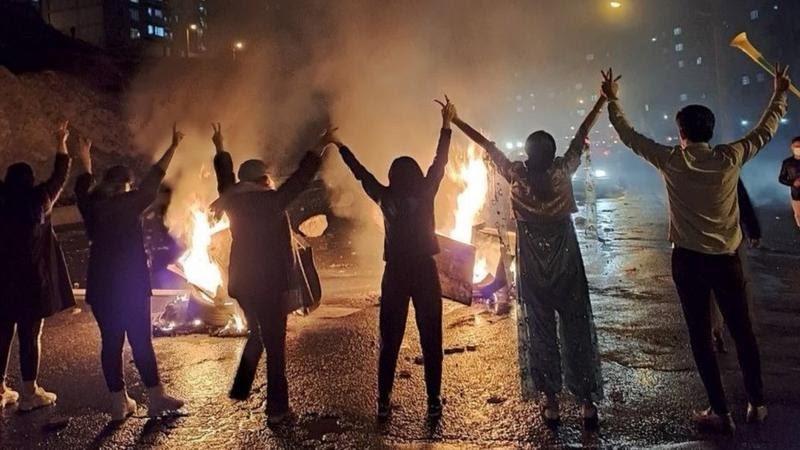
The Iranian people courageously launched a “national revolution” to end the Khomeinist regime. However, letting a peaceful people, armed only with their will, confront a notably repressive regime goes against the commitment of the free world to defend fundamental rights. The Iranian will is perfectly explicit. Yet, the stifled voice of the people requiresinternational support. Which demands a concrete, realistic, and effective strategy.
Recognition of the legitimate representative of the people
The recognition of a representative of the people of Iran by democratic States remains a viable non-military solution. However, this implies a commitment from these states to regime change, and thus requires a willingness to support Iran in its quest for freedom.
In this regard, Crown Prince Reza Pahlavi represents a historic opportunity as the heir of the dynasty that built Iran and liberated its women. Neutral and non-partisan, he can convey the popular will rather than defend the interests of a political party. By defending the interests of a politically diverse people since 1979, Pahlavi illustrates the unifying role of a monarch. This would place him as a guarantor and protector of a pluralistic, liberal, and humane democracy that encompasses all Iranian democratic political colors.
The recognition of a representative rests on political and sociocultural legitimacy. The Prince enjoys traditional legitimacy, as well as a royal title conferred by the pre-Khomeini Constitution. He has contested the legitimacy of the regime since its inception that occurred against the will of the previous sovereign, the Shah of Iran, who never abdicated. These highlighted circumstances can influence the policies of recognizing States.
Furthermore, this position of the Prince will enable recognizingStates to avoid the weaknesses of the Syrian coalition. An Iranian coalition, without legal basis or legitimacy, would have limitations and is unnecessary when there is a legitimate monarch. The monarch can instead gather expertswho can organize to implement initiatives. A coalition is also not recommended, as political fundamental divergences would hinder peaceful transition. Recognition of the representative implies that they will be the sole to receive international support, which sends a clear message to the various opposition groups to rally behind this representative. It is an effective unifying means compared to the recognition of a coalition.
Consequently, Reza Pahlavi, as a legitimate monarch in exile, appears capable of claiming this recognition with the privileges that accompany it. This role would enable him to work and negotiate with the international community according to the strategy he advocates: “maximum support” for the people and “maximum pressure” on the regime.
Triggering a defection in the regime
We know that the loyalty of the armed forces is essential for tyrants to remain in power. A credible political alternative to the regime would be likely to attract this loyalty, thereby weakening the regime whose existence depends on its strength. To uproot the Islamic Republic, a defection within the system is necessary. The recognition of a representative can trigger that defection.
According to Majid Tavakoli, a prominent scholar and political prisoner in Iran, the opposition must be based abroad and have a clear plan to control the army. This control first requires that the commander-in-chief of the alternative have sufficient authority to trigger disobedience on the part of military personnel to the orders of current commanders.
The Prince, coming from a family of military and holding a combat pilot license obtained in the United States, possesses all the qualifications to earn the respect and loyalty of the armed forces. He naturally embodies the political figureheadcapable of leading a peaceful transition to democracy.
Peaceful political transition
After the revolution, the transitional period must establish a stable and secure environment conducive to organizing a free and fair referendum on the form that the government should take. Often, the fall of a political regime creates a power vacuum that groups, potentially armed, seek to fill. Thus, this transition must be carried out through a constitutional process to immediately fill this vacuum and avoid internal divisions and power struggles. Only the reinstatement of the pre-Khomeini Constitution, updated accordingly, has the capacity to guarantee a smooth transition and the proper functioning of the country, ensuring the rule of law.
The reality, far from being an idealistic and partisan slogan, shows that the Prince has remained faithful to the principles and values of the diplomatic world over these past four decades. The consistency in his words testifies to his determination not to deviate from his democratic and secular convictions. He has the potential to ensure peace and stability at both national and regional levels, by establishing an interim government.
However, some polarized groups prefer to attack the Pahlavis rather than unite against the regime, reproducing the same tactic on which the regime was built. To usurp power and maintain it to this day, the regime used a global anti-Pahlavi campaign of disinformation in academic and media circles. Ultimately, the national revolution of the Iranian people is not only a struggle against an Islamist regime, but also a fight against disinformation.


Leave a Reply