
Charlene Savadkouhi
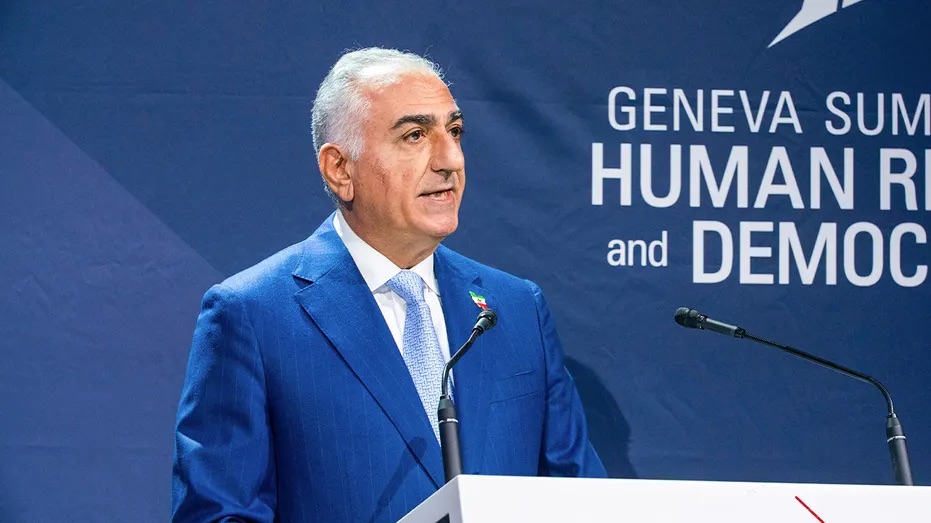
The grand hall in Geneva was filled with an air of anticipation, the kind that preceded historic moments. Journalists whispered among themselves, analysts scribbled notes, and diplomats adjusted their headsets, ready to hear the words of a man whose name carried the weight of a fallen empire and the hope of a resurrected nation.
As Reza Pahlavi stepped onto the stage, the room fell silent. Not out of mere courtesy, but because his presence alone spoke of unfinished legacies and the restless ghosts of a nation still waiting for justice.
He scanned the crowd—many were strangers, but among them were his fellow Iranians, men and women who had traveled thousands of miles, exiles by fate, revolutionaries by choice. They had come not just to listen, but to witness.
And then, with a steady voice that carried the gravity of history itself, he began:
We are not just fighting against the Islamic Republic. We are fighting for Iran.
The words echoed through the chamber, simple yet profound. This was not just about toppling a regime; it was about reclaiming a nation that had been hijacked, stripped of its identity, and sold to the highest bidder in the name of ideology.
The Fire That Consumed a Nation
He spoke of deception—of how the world had watched as a cleric, cloaked in false piety, deceived a people desperate for freedom. The revolution of 1979 had been painted as a victory for justice, a dawn of democracy. But those who had lived it knew otherwise.
“The Cinema Rex fire in Abadan,” he reminded them, “was the true face of that revolution before it even began.”
Over 400 innocent people, burned alive—not by the Shah’s forces, as the revolutionaries claimed, but by the very extremists who would soon seize power.
They had killed, lied, and manipulated their way to the throne, and the world had cheered.
A Systematic Erasure of a Nation’s Identity
The Islamic Republic’s war was never just against political dissenters. No, it was against Iran itself.
Pahlavi spoke of the erased names, the forbidden books, the ancient monuments left to crumble.
“They want Iran to forget itself,” he said, and in that moment, the room understood the depth of the crime. This wasn’t just political repression, it was cultural extermination—the methodical destruction of a civilization that had existed long before their theocracy was born.
They banned the name Cyrus, neglected the ruins of Persepolis, and sought to replace Iran’s millennia-old identity with an Islamist ummah.
But Iran was not merely a country—it was an idea, a civilization that had survived Mongol invasions, colonial interference, and now, the parasites that ruled from Tehran.
The Women Who Refused to Bow
“When they took power,” he continued, “the first law Khomeini repealed was the Family Protection Law.”
Not a law about oil, or borders, or foreign policy. A law that protected women.
That told the world everything it needed to know about the nature of this regime. Before they could silence the nation, they had to silence its women.
But Iranian women were never meant to be silent.
From the streets of Tehran to the prison cells of Evin, they had resisted—Fatemeh Sepehri, Nasrin Shakarami, Nahid Shirpisheh—names the world should have known but had ignored.
“Why?” he asked the silent audience. “Because some human rights organizations have allowed ideological bias to decide who gets heard and who remains voiceless.”
The hypocrisy of the West was laid bare in that moment.
An Unyielding Nation
“They tried to divide us,” he declared, “but they failed.”
The regime had tried to exploit ethnic and sectarian divisions, to create fractures where none existed. But the streets of Iran told a different story:
“From Zahedan to Kurdistan, I give my life for Iran.”
The crowd in the hall stirred. The chant had not come from a Twitter campaign, nor a foreign-funded think tank. It had come from the bloodied lips of protesters on Iranian soil.
Iran was not a collection of tribes or factions. It was one nation, bound by something deeper than ideology—by history, by blood, by an unbroken chain of ancestors who had built civilizations while their oppressors were still wandering the deserts.
The Crimes Beyond Iran’s Borders
But the Islamic Republic’s evil did not stop at Iran’s borders.
“They are holding foreign citizens hostage,” he said, his voice cutting through the silence like a blade. “They use embassies as terror cells. They fund groups that murder the innocent from Beirut to Buenos Aires.”
And yet, some in the West still sought to negotiate with them.
His gaze turned towards the diplomats in the room. How many of them had shaken the hands of Iran’s murderers in quiet backroom meetings?
How many would leave this conference and return to their comfortable policies of appeasement?
A Strategy for Victory
Pahlavi did not come to Geneva to merely lament the suffering of his people. He came with a plan:
• Mobilizing grassroots networks inside Iran.
• Unifying the diaspora to amplify the demands of Iranians inside the country.
• Pressuring G20 governments to isolate the regime, while supporting the people.
• Encouraging defections within the military and government.
• Preparing for a democratic transition and national reconstruction.
There was no begging, no appeals for sympathy. Iran did not need saviors—it needed allies.
“The Iranian people do not ask for your pity,” he said. “They ask for your partnership.”
The Last Stand Against Tyranny
This was not just about Iran’s survival—it was about the stability of the entire world.
The terrorist regime in Tehran would never stop waging war on the free world until it was removed.
He had spoken with leaders across Europe, he told them. He knew who stood with the Iranian people and who would prefer to wait and watch.
But Iran’s revolution would not wait for anyone’s green light.
And to those who tried to silence the movement or stood in its way, he had one message:
“History is moving forward. And Iran is coming with it.”
The room was still. The weight of the moment pressed upon them.
This was not just a speech.
This was a declaration of war against the forces that had enslaved his nation for 45 years.
And for the first time in decades, Iran’s true heir was not just speaking of the past—he was claiming the future.


Leave a Reply