
Shahin Modarres
The term ideology was first used by Antoine Destutt de Tracy, eighteenth century philosopher of the French Enlightenment school. Ideology can be translated as “the study of ideas,” and de Tracy meant it as “the science of the formation of ideas.” Of course, contrary to what his opponents have contended, de Tracy’s intention was not to shape people’s ideas in a social engineering scheme, but to analyze how the ideas and rationality governing human behavior in societies are formed and to assess its characteristics. In other words, ideology was meant to represent a methodical study of human action.
De Tracy saw ideology as a superscience that integrated all political, economic, and social factors in order to provide insights into human behavior. Ideology was supposed to be the greatest of arts, for whose success, all other sciences had to be in perfect harmony, so that society could be organized in such a way that man would receive the most abetment and the least disruption from his fellows.
The concept of ideology according to the de Tracy’s definition seems largely obvious: none of the branches of human sciences could continue without attention to other disciplines and inconsistent with the general nature of human beings and societies. For example, studies in economics that ignore moral and political principles are worthless at best.
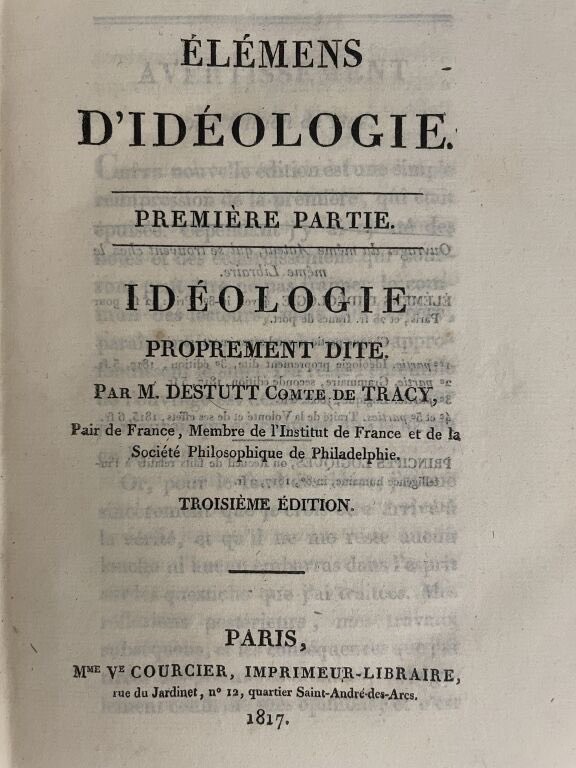
De Tracy described his theory about ideology in detail in his four-volume work, Elements of Ideology. This book is a treatise on methodology that ultimately concludes with de Tracy’s theory of political economy. De Tracy, who was himself a passionate supporter of laissez-faire, was able to attract the opinion of many French liberals and had a relatively deep impact on the French intellectual atmosphere.
But his influence and success did not last long. Upon consolidating his power as the Emperor of the French, Napoleon declared his vehement opposition to ideology. He derisively labeled de Tracy and his colleagues, who called themselves “ideologists,” as “ideologues.” Napoleon’s hostility to ideology had an obvious reason: his ambitions and endeavors could not be justified according to any comprehensive theory in human sciences (or ideology).
Later, Karl Marx also despised ideology in his critique of political economy, and his reasons were no different from Napoleon’s. According to Ludwig von Mises’ explanation in the introduction to his book, Human Action, nineteenth century socialists were completely disarmed against a comprehensive science of human action. Under these circumstances, Marx provided a misleading definition of ideology and by rejecting the possibility of any comprehensive theorizing in all sciences, he paved the way for his attacks on all human scientific achievements.
Marx’s path continues to this day. On the one hand, in the media and treatises, every non-scientific and mind-boggling belief and cult is labeled as an ideology; And on the other hand, many university professors call their critics “ideologues” and steer clear of criticism. For example, an economics professor scorns criticisms that come to him from the point of view of political science or moral philosophy, and calls them “ideology-infested.”
According to de Tracy, only a coherent ideology can reveal the deterioration of methodology, and the deviation and futility of various branches of human sciences in today’s universities.


Leave a Reply