
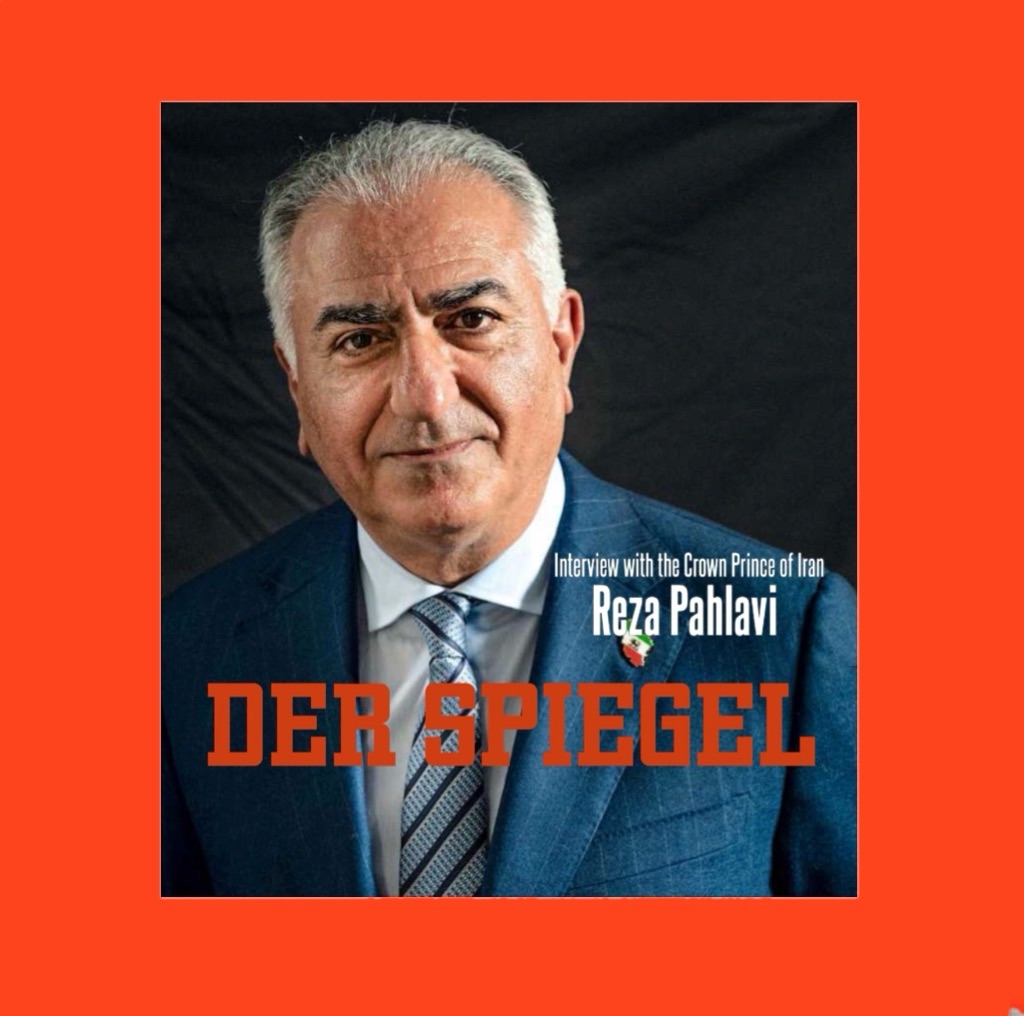
English translation of Der Spiegel’s interview with Crown Prince of Iran, Reza Pahlavi
SPIEGEL: Mr. Pahlavi, you were an 18-year-old crown prince when you had to leave Tehran 45 years ago in the wake of the Iranian revolution. For several years you have offered yourself as a beacon of hope for a system change in the country. Could the death of President Ebrahim Raisi contribute to this? After all, he was considered the likely successor to the 85-year-old Supreme Leader Ali Khamenei.
Pahlavi: The death of Raisi changes little. Raisi was a brutal mass murderer, a long-time servant of Ali Khamenei and the Islamic Republic. The Iranians do not mourn his death. Mr. Mokhber …
SPIEGEL: … the previous first vice president, who has just been appointed interim president …
Pahlavi: … is a long-time regime functionary in the Supreme Leader’s office. Like Raisi before him, he will serve as his lackey. The Islamic Republic’s policies will therefore continue with Ali Khamenei as dictator at the helm.
SPIEGEL: You have stayed in the background for a long time. Now you are actively fighting to overthrow the government. What do you want?
Pahlavi: Actually, I am not saying much differently today than I did 40 years ago. A lot has happened there since I left Iran, and nothing for the better. Given its rich resources and capabilities, Iran should have developed into at least the South Korea of the Middle East. Instead, we have become the North Korea of the Middle East. Nobody believes in reform anymore, and Iranians are looking for a scenario for transition. There are high expectations of me. That brings me to my commitment. I am running to take the lead, and I want to serve my country.
SPIEGEL: The Iranians drove your father out in disgrace in 1979 because of his authoritarian leadership style and social injustice, and you were not allowed to stay either. What gives you the confidence that today’s population wants you to return?
Pahlavi: I get an overwhelming response, I read what is being written on social media in Iran. I hear Iranians chanting my grandfather’s name at football matches, I see young Iranians getting my father’s signature tattooed on their arms. For me, these are clear signs that many Iranians have revised their position at the time and that the younger generations want change – despite the indoctrination they have been subjected to there for decades.
SPIEGEL: Your father ruled with a heavy hand, according to human rights organizations, numerous political prisoners were imprisoned, many were tortured and killed. That is also unforgettable in Iran.
Pahlavi: There was a political crisis, there were deficiencies. No system is perfect. But Iranians have recognized that the goal of my ancestors’ Pahlavi dynasty was modernization: the introduction of infrastructure, education, land reform, health care and equal rights for women. In a way, Iran was avant-garde at the time, women were granted the right to vote eight years before Swiss women. Until a revolution took place that took over our country.
SPIEGEL: You never distanced yourself from the violence of your father’s notorious Savak secret service.
Pahlavi: There is justified criticism. I address these issues openly in my books. But there was also a disproportionate exaggeration of facts, especially on the part of radical Islamists and Marxists. They had an interest in denigrating the government, which was largely pro-Western and did not agree with their ideologies. Historians should examine this.
SPIEGEL: Much is known, however.
Pahlavi: But I am not my father either. I have my own plans, my own vision, and I should be judged by what I propose.
SPIEGEL: That would be?
Pahlavi: I offer myself to Iranians in this process as an honest broker of the transition to a new era. I try to tell people not to just hope for better times, but appeal to them: Let’s start believing that we can actually do this. My goal is to guarantee the rule of law for every single citizen – including women’s rights, ethnic, religious and LGBTQ rights.
SPIEGEL: Tehran is ruled by an autocratic government that brutally demonstrated its determination to defend power with all its might during the last uprising, after the death of the 22-year-old Iranian Kurdish woman Mahsa Jina Amini in police custody. How do you intend to get rid of this government?
Pahlavi: Anyone who analyzes this regime, whether in Iran or outside, no longer believes that it can be reformed. We see that even radical, pro-regime people are turning away, such as a former editor-in-chief of “Kayhan,” the country’s most conservative newspaper. The man was very close to the revolutionary leader Ruhollah Khomeini. He currently lives in Toronto because he no longer believes in the Islamic Republic and wants change.
SPIEGEL: The most recent uprising has cost the lives of more than 500 Iranians since 2022, and tens of thousands of demonstrators have been arrested, tortured, and some even executed. Do you want a new Iranian revolution?
Pahlavi: Yes, I want a revolution. The Iranians are still willing to make sacrifices. Because they know that their country is doomed if we don’t get rid of this regime.
SPIEGEL: That’s easy to proclaim from the lobby of a five-star hotel in London.
Pahlavi: The last uprising was already a revolution. An authentic reaction to oppression, not because I called for it. The demonstrators chanted “Death to the dictator.” Ali Khamenei, who represents this system as the revolutionary leader, is rejected by at least 80 percent of Iranian society. The regime has crushed this uprising with all the instruments of repression at its disposal. But it is much weaker than ever before; it is divided. Parts of the military and paramilitaries are worried that they would be the first victims of acts of revenge if the situation escalates. There are already defectors.
SPIEGEL: The regime still has supporters. There are many very rich Iranians who benefit from this regime, and hundreds of thousands of supporters in the security apparatus for whom the current political model is very profitable. Why would they switch sides?
Pahlavi: The top commanders of the regime benefit the most. The lower classes and ranks only get a paycheck, which is sometimes not even enough to pay the rent. They also drive taxis without paying, collect bribes and are completely disillusioned. To maximize the chances of a revolution succeeding, we would have to offer as many of them as possible the opportunity for reconciliation.
SPIEGEL: Are you talking about a general amnesty for a peaceful transition in the event of a possible coup?
Pahlavi: Of course, some people have to answer for their actions and be held accountable. Nevertheless, I believe that we have to stop the cycle of revenge and retribution. That is what sets us apart from this regime. We believe in human rights. We believe in due process.
SPIEGEL: Who exactly do you mean when you say “we”?
Pahlavi: Myself, the team that works with me, and the majority of Iranians who support this position.
SPIEGEL: Why have the various forces of the opposition in exile not been able to agree on a common approach for decades? Who are you cooperating with?
Pahlavi: When I appear with representatives of the opposition, as I did recently at Georgetown University in Washington, I see it as symbolic cooperation. It seems more important to me that there is great unity in Iran and a common vision. That is what counts.
SPIEGEL: You have lived in the USA for four decades. It is said that you are much closer to the Republicans than to the Democrats. Are you already talking to the former and possibly next US President Donald Trump about regime change in Tehran?
Pahlavi: I have not yet met Mr. Trump, but I have been in talks with representatives from both camps over the years. I find people on both sides who share our vision. Essentially, it is about the fact that four decades of efforts to achieve the desired change in the Iranian leadership’s behavior have clearly failed. The arguments do not change whether I am facing Donald Trump or Joe Biden. The question is which path you consider to be the right answer!
I will encourage my compatriots
to boycott these so-called elections
SPIEGEL: You are calling on the EU to finally take off its kid gloves towards the Islamic Republic. What does that mean?
Pahlavi: For decades, governments in Washington, London, Berlin and Paris have tried to avoid confrontation with the regime. The result is that 60 percent of the people there live below the national poverty line, the regime and its proxies spread terrorism in the region and pose a nuclear threat.
SPIEGEL: A little over a year ago you visited Israel, a declared opponent of the Islamic Republic. You discussed your possible political future in Iran with Prime Minister Benjamin Netanyahu and the secret service. Have you been united in the fight against the Islamic Republic since then?
Pahlavi: The goal of this first ever trip by an Iranian politician to Israel was to explain to the Israelis what a secular, democratic Iran could mean for them and the Middle East. What it means when the Iranian nation lives in peace with its neighbors and maintains friendly relations, when the country is not hostile towards the Arab world and the existence of Israel. Our relations with the Jews have existed since Cyrus the Great.
SPIEGEL: The Persian king and military strategist who forged the Iranian peoples together until 530 BC.
Pahlavi: Why shouldn’t Iran seek an extension of the Abraham Accords with Israel, as has already been concluded between Israel and the United Arab Emirates and Bahrain and Morocco? We could call it the “Cyrus Accords.” Iran could be part of the peace formula for the Middle East – for Saudi Arabia and the people of Israel, Lebanon, Syria, Iraq and beyond.
SPIEGEL: Do you want to turn back the clock to the era when your father ruled?
Pahlavi: Even then, geopolitical conditions were complicated. The Berlin Wall was still standing, the Cold War was dominant. The Soviet Union and its allies were the enemies of the Western world. But Iran played an important role in stabilizing the region. We had very good relations with the West, but also with the Eastern bloc, with China and the Soviet Union. We did not want to become victims of this tug-of-war between East and West; we pursued a balanced approach. The regime completely destroyed this balance and led to instability, hostility and radicalism.
SPIEGEL: But now you are promoting change in democracies, in the USA, in Europe – and also in Israel. Is this perhaps a military option to force a new state order in Tehran?
Pahlavi: Let me be clear: I have not received any support from the USA so far, at least not from the current government, and I definitely do not want a military attack or a possible war against my country. I am only talking about civil disobedience.
SPIEGEL: Despite all the sacrifices that Iranians have made so far, the resistance has been unsuccessful. The recent protests have painfully shown this.
Pahlavi: It is about giving the Iranians who want change the maximum possible support. At the same time, we must develop an exit scenario and offer a way out to those who are currently trapped within the system of the Islamic Republic. I am thinking of examples of national reconciliation such as in South Africa; we need transitional justice and a constitutional process that will prepare the transition legally.
SPIEGEL: You want to make offers to potential defectors?
Pahlavi: In order to lose as few human lives as possible in this process, we must reduce the resistance of those who have the weapons to a minimum. So if those in power try to commit genocide at the last minute, the Iranian security forces must become a protective shield for their own population.
SPIEGEL: How should that work?
Pahlavi: The 90 percent of the armed forces that do not profit from the corrupt leaders are in an untenable situation. And a regime that only has ten percent of supporters cannot survive in the long term.
SPIEGEL: The rulers there have held out for quite a long time.
Pahlavi: The question is not whether the regime will disappear, but when, and whether we have given Iranian society the maximum support. Specifically, whether we can accelerate the downfall of the Islamic Republic before it reaches the threshold of possessing a nuclear weapon. Because then we will have a completely different conflict situation. That could happen in half a year or two years. So we have no time to lose.
SPIEGEL: So if Iran has nuclear weapons, the hope of a change of power will end?
Pahlavi: A nuclear-armed Iran would have catastrophic consequences. A global conflict with God knows what consequences is conceivable. I would like to spare the Iranians and the world that.
SPIEGEL: In your speech in the EU Parliament in Brussels last year, you called for the powerful Revolutionary Guards to be classified as a terrorist group, like in the USA. This step would increase tensions between Iran and the EU to the maximum. What would that achieve?
Pahlavi: Foreign governments should increase the pressure on the regime by imposing further sanctions, particularly against the Revolutionary Guards. What other options do you have against a corrupt mafia that wants to arm itself with nuclear weapons if diplomacy does not work and you want to avoid a military conflict? At the same time, you need maximum support for dissidents and activists, help with financing Internet access in Iran and for strikes and so on. We must empower all those who are disappointed with the regime. If this happens, more and more radicals will break away and enter into dialogue with us. We must create a maximum of defection.
SPIEGEL: You were the crown prince of the last monarchy. You never gave up your title. In what role would you like to return to Iran, as monarch, prime minister, president?
Pahlavi: You are putting the cart before the horse. My goal is a secular nation, a democratic process that ensures that every vote is heard and counted, fair and transparent. I just want to be a facilitator of this transition. That’s it. I have no intentions beyond that.
SPIEGEL: Some of your supporters are vehemently demanding the reinstatement of the monarchy. Would that also be your preference?
Pahlavi: It is their right to demand that. Iranians should be free to choose the next form of government – whether a parliamentary monarchy or a republic. That will be decided at the ballot box.
SPIEGEL: Do you hope that the current crisis following the death of President Raisi will bring you closer to a return to Iran?
Pahlavi: Supreme Leader Ali Khamenei has already called for new elections. Of course, they will be rigged again. I will encourage my fellow countrymen to boycott these so-called elections. The aim is to deepen the already existing division within the Islamic Republic – and to win over those who turn away from this system to the opposition movement.
SPIEGEL: The fall of your father in 1979 was also a personal tragedy for your family. For many months, no one wanted to take you in, then your father died. Two of your siblings became depressed and died tragically. Is your political approach also an attempt to come to terms with your own life story?
Pahlavi: I remember a conversation with my sister, who was depressed about what happened at the time, and I said to her: “Don’t worry so much! You can’t change the past, only what happens in the future.” In that sense, I have never looked back. Whether you are loyal to the regime in Tehran today or belong to the opposition – the result of the Islamic Revolution is a catastrophe. But I survived it all and carried on because I have a mission for my country, because Iran deserves better. I believe we can do this and will return home one day.
SPIEGEL: Mr. Pahlavi, thank you for this interview.


Leave a Reply