The Apadana Telegraph Editors
On May 22, 2024, Iranian American dissidents gathered in front of the “Islamic Education Center” in Potomac, Maryland to protest a memorial ceremony for Ebrahim Raisi, the president of the Islamic Republic regime, dubbed the “butcher of Tehran,” who died in a recent helicopter crash. As they chanted anti-regime slogans, a man wearing all black with a Palestinian Keffiyeh on the left shoulder is seen making a menacing motion at them, perceived by the protesters as a death threat.
Mercenaries of the Islamic Republic regime are running rampant in the U.S., threatening Iranian American dissidents with impunity.
How did we get here?
The Iranian American community can thank the National Iranian American Council (NIAC) for the presence of these baleful louts on U.S. soil.
In the midst of the 2009 “Green Movement” in Iran, NIAC’s president Trita Parsi wrote an email to Antony Blinken, national security advisor to then-Vice President Joe Biden, insinuating that he was the spokesman for the “opposition” and the Iranian American community at large. In that email, he issued several “strategic directives” for the Obama Administration to follow with respect to the uprising.
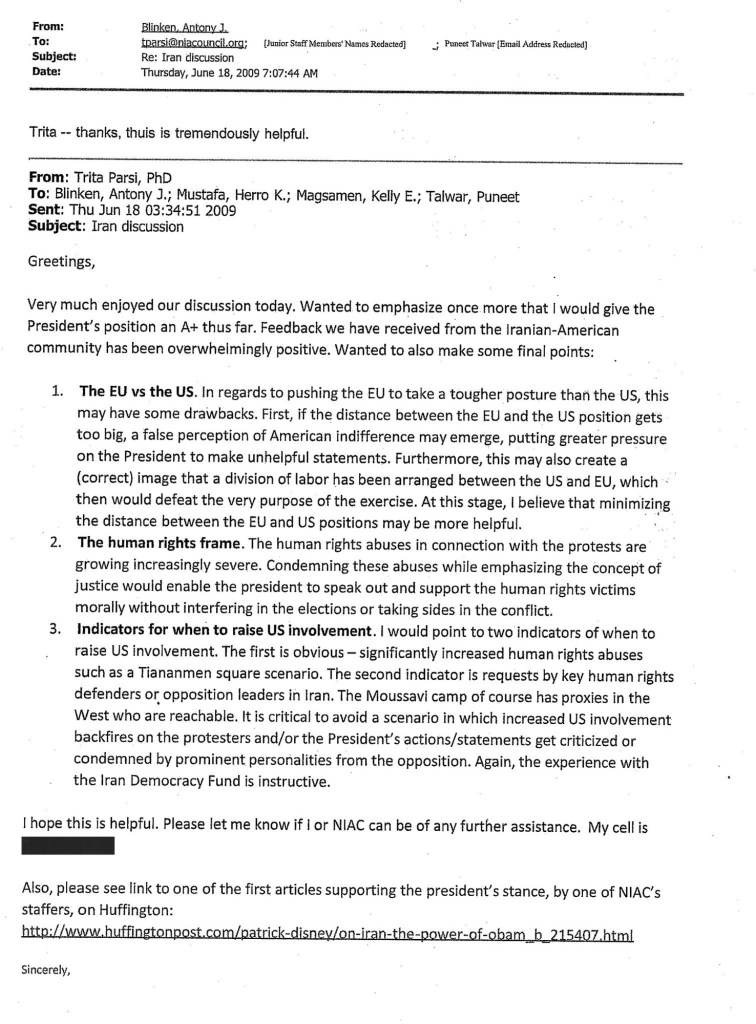
The corollary to that email was a new generation of dissidents, as well as an “opposition group” that was created entirely and controlled by the regime, with a special allegiance to the Islamic Republic’s reformist faction. Khomeini’s former Prime Minister Mir Hossein Moussavi was presented as the main opposition figure, and his supporters were portrayed as dissidents. Individuals close to NIAC promoted the kind of propaganda that shaped this awkward school of thought and repeatedly called the Islamic Republic “reformists” the true opposition and anything outside of that circle, the fake opposition.
A mass exodus of such “political dissidents” made its way into the U.S., as the Obama administration followed through with its “humanitarian” efforts to ostensibly move these individuals out of harm’s way in Iran and bring them to America. Many of these individuals were briefly detained by the Islamic Republic regime’s security apparatus for their presumed participation in rallies. They naturally presented themselves as former political prisoners. Astonishingly, they were released by the regime without incidence and immediately were allowed to leave Iran. Many came to the U.S.
These individuals, of course, were no ordinary dissidents. They subscribed to the ideology popularized by a group of regime personalities that was presented to the Obama administration as the “moderates.” Thus began the mythical dichotomy of “moderates versus hardliners” within the Islamic Republic’s political anatomy. This concept was a complete fallacy, as both of these factions had one objective: preservation of the regime and consolidation of Supreme Leader Ali Khamenei’s power at any price.
The first and foremost campaign that those so-called dissidents tackled was to persuade the U.S. to ease sanctions on the regime. This was accomplished through advocating diplomacy and rapprochement with the mullahs over their illicit nuclear program.
The campaign to reach a deal with the regime was enormous, and was spearheaded by NIAC. The outcome was the now-defunct Iran Nuclear Deal, or the Joint Comprehensive Plan of Action (JCPOA), agreed upon in 2015. The “dissidents” who had taken refuge in the U.S. were candidly supporting and advocating for the oppressive regime they had escaped from. These individuals were (are) well-known amongst authentic Iranian American dissidents.
The immigration of Iranians of questionable past intensified after the JCPOA. As a side deal to the JCPOA, the Obama administration agreed to grant approximately 2500 immigration visas (Green Cards) and/or U.S. citizenship to individuals of the regime’s choosing. It is also believed that as a part of the JCPOA package, former regime Foreign Minister Mohammad Javad Zarif was working on visa-free travel to the U.S. by Iranian nationals. This effort was promptly and appropriately halted by Congress. Zarif, an astute propagandist, called this legislation a breach of the JCPOA. If this arrangement was to move forward, it would have had devastating consequences for Iranian American dissidents; much worse than what it experienced by them today.
In parallel to the JCPOA, NIAC, in collaboration with another organization called The Public Affairs Alliance of Iranian Americans (PAAIA), launched a massive lobby campaign that advocated for easing visa restrictions for Iranian nationals. This was done on the pretext of “uniting families.”
The floodgates of unbridled immigration of Iranians to the U.S. were now open. Among these immigrés were former and current members of the Islamic Revolutionary Guard Corps (IRGC) and the Basij militia.
An appalling example is the case of Seyyed Mohsen Dehnavi. Dehnavi, a hardline Islamist who is currently a member of the Islamic Parliament, came to the U.S. on a J-1 visa in 2017 to work as a “research scholar” at Boston Children’s Hospital. He was detained at Boston’s Logan International Airport and sent back to Iran after being denied entry. NIAC and Trita Parsi sensationalized the affair as an example of a discriminatory immigration policy enforced by the Trump administration; a policy they labeled as the Muslim Ban. While the Department of Homeland Security contended that Dehnavi’s denial and subsequent deportation was due to his affiliation with the Basij, Parsi rejected this explanation and attributed it to what he and NIAC called the Muslim Ban.
It later became evident that Dehnavi was a violent ringleader of Basij militia at Sharif (formerly Aryamehr) Institute of Technology responsible for multiple cases of physical assault on students.
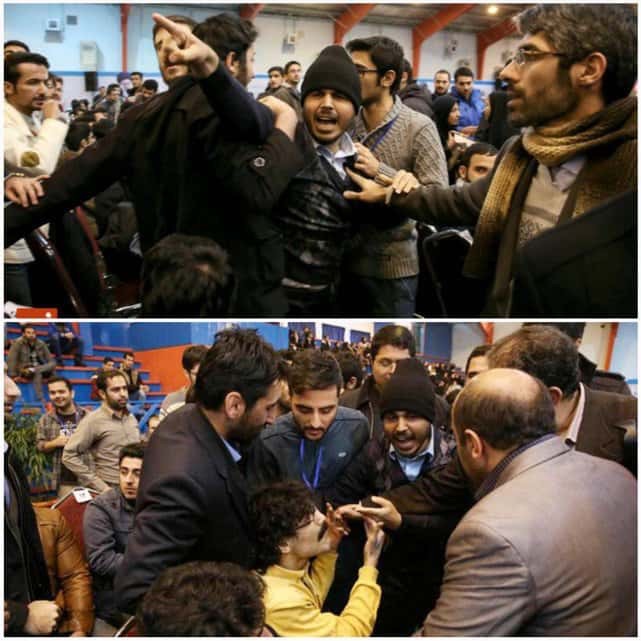
NIAC partnered with the Council on American–Islamic Relations (CAIR) to fight against the Muslim Ban, calling any restriction on the entry into the U.S. of radical Islamists, including staunch Khamenei supporters, discriminatory and Islamophobic.
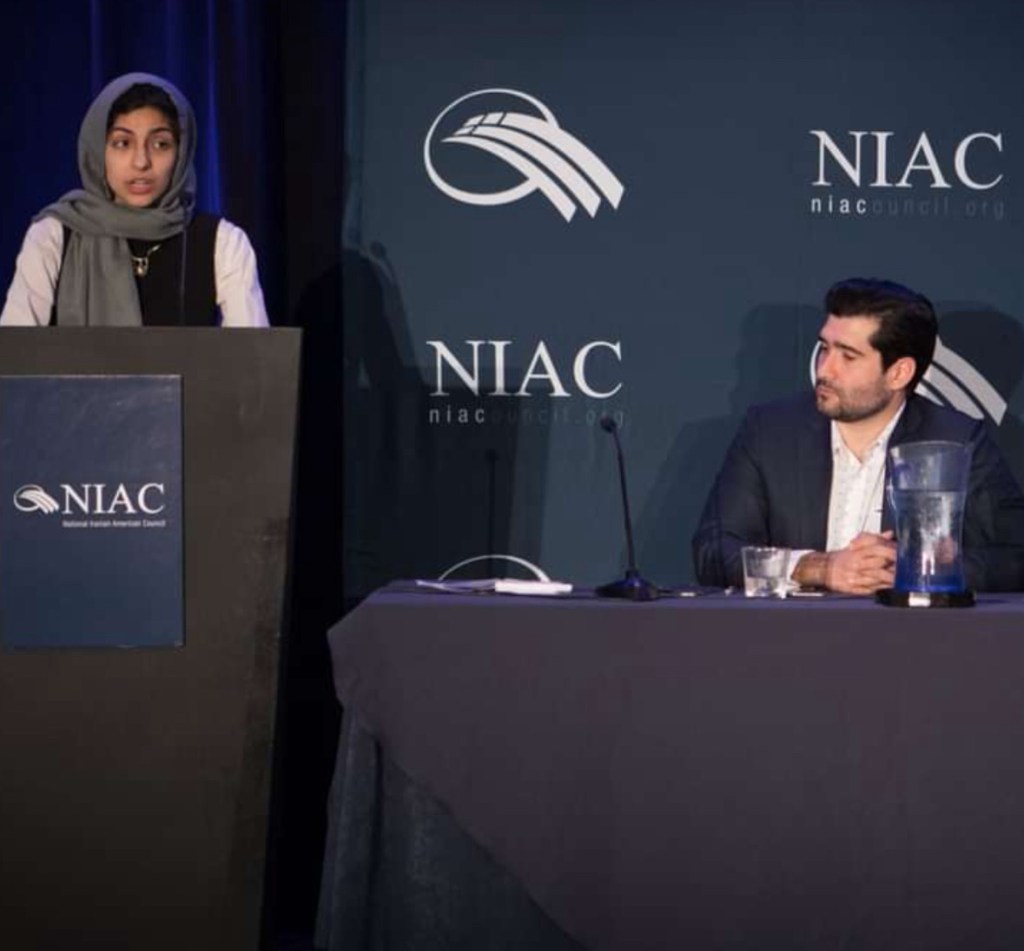
In time, the Trump administration walked backed on and eased some of the constraining aspects of its immigration policy regarding Iranian nationals. Yet, not so much of the toothpaste could be pushed back into the tube while the restrictive policy was in effect.
It is now common knowledge among Iranian American dissidents and the community at large that NIAC pursues and advocates for policies that serve the Islamic Republic regime’s interests. In 2020, three Republican senators, Mike Braun (Ind), Ted Cruz (TX), and Tom Cotton (Ark) called on the U.S. Department of Justice (DOJ) to investigate NIAC, which they believes acted as a “foreign agent of the Islamic Republic.” The senators sent a letter on January 14, 2020 to then Attorney General William Barr, urging the DOJ to investigate NIAC and its sister organization, NIAC Action, for potential violations of the Foreign Agents Registration Act.
Iranian American dissidents have repeatedly outed Trita Parsi, currently the vice president of the Quincy Institute for Responsible Statecraft, as a dubious figure close to the Islamic Republic regime, acting as a lackey of Zarif,
NIAC and Trita Parsi have a lion’s share of responsibility in relation to the presence of regime mercenaries and agents of the IRGC on U.S. soil. The Iranian American community should not remain silent with respect to this threat on their civil rights, and egregious compromise on their safety and security. In essence, NIAC and its affiliates brought this curse upon the Iranian American community.


Leave a Reply