
Cyrus Parsa
Hezbollah has now been effectively relegated to history’s margins. Any further attempts to establish a leadership team or organize will be nothing more than a hollow and futile façade.
Leaders like Hassan Nasrallah, who have held prominent positions for years through propaganda and substantial support, cannot be replaced overnight. Just as the Ismlsmic Revolutionary Guard Corp’s Quds Force faded into obscurity after Qassem Soleimani, or how Hamas has been left confused and disoriented after Ismail Haniyeh, Hezbollah too has reached its end.
Totalitarian regimes and their subsidiary organizations are deeply dependent upon individual figures. They rely on the presence of a specific leader, and there is no real meritocracy within the middle and lower ranks.
Even in the higher ranks, it is not competence or capability that defines leadership, but rather one’s loyalty and faith in the system that guarantees a permanent position of authority. Thus, just as the loss of Soleimani dealt an irreparable blow to the regime, Hamas and Hezbollah will never recover from the collapse of Haniyeh and Nasrallah.
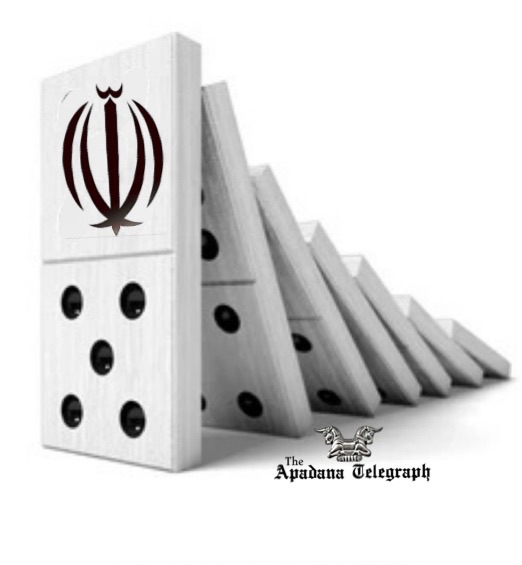
The regime’s domino effect of collapse began with Ali Khamenei’s reckless decision on ‘October 7th’; It accelerated with the elimination of Hamas’s leaders and intensified with the downfall of Nasrallah and Hezbollah’s command team. In the next phases, the positions of the regime’s proxy forces in Syria, Iraq, and Yemen will undergo significant changes.
For instance, it is not far-fetched to expect increased infighting among the various military and paramilitary forces in Syria and Iraq. Chaos will engulf the region—chaos that will lead the regime to lose its grip over its areas of influence. Its illusory authority will become even more evident, even in the eyes of its most loyal supporters. This will become a crucial factor in the defection of loyal military forces from the regime.
After Hezbollah’s downfall, the regime will never regain its former propagandized position in the region. Nasrallah’s demise was an even heavier blow than Soleimani’s death, shaking the fragile foundations of the regime’s influence and power in the region.
Fear has now overtaken the regime’s leaders, particularly the military commanders. It is no longer clear who, in an effort to save their own life, might hand over the regime’s most vital secrets to Israeli intelligence. Khamenei is nearing the end of his path, and this is where the vision of the ‘Cyrus Accords’ emerges; a framework of peace and cooperation between a future free Iran and Israel.
Drawing inspiration from Cyrus the Great, who allowed Jewish exiles to return to Judea, the ‘Cyrus Accords’ represent a potential realignment in the Middle East.
The vision is that after the fall of the Islamic regime, a democratic and secular Iran could restore ties with Israel based on mutual respect and historical connections.
In summary, the collapse of the regime and its proxies could pave the way for a new order in the Middle East. The ‘Cyrus Accords’ offer a hopeful vision of what a post-regime Iran could look like: a nation reborn, engaged in peaceful relations with its neighbors, particularly Israel, and committed to fostering stability and economic growth. As the regime continues to weaken, this vision becomes more plausible, marking the dawn of a new era for the region.


Leave a Reply