
Cyrus Parsa
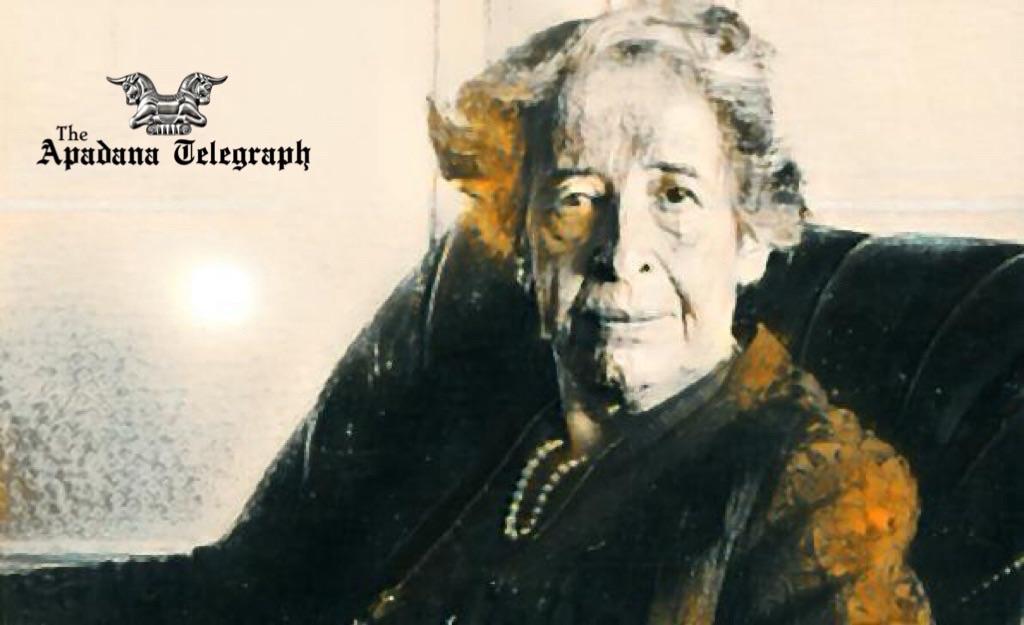
In her seminal work The Origins of Totalitarianism, Hannah Arendt describes totalitarian regimes as systems that seek not only external control but also domination over the innermost layers of human existence. The Islamic Republic of Iran serves as a vivid, living example of such a regime.
The Islamic Republic does not stop at political or economic repression. Under the pretense of creating an “Islamic society,” it targets both individual and collective lives. From enforcing mandatory veiling to interfering in personal beliefs and lifestyles, the regime’s ultimate goal is to reconstruct minds and compel wholehearted acceptance of its authority.
A Totalitarian Ideology: Shiite Fundamentalism and State Socialism
The Islamic Republic’s totalitarian ideology blends Shiite-centric dogma with state socialism. Shiite dogma rejects popular sovereignty and labels all dissent as “counter-revolutionary.” Meanwhile, state socialism centralizes resources in governmental institutions such as the Islamic Revolutionary Guard Corps (IRGC), using this economic control as a tool for repression.
This ideological fusion provides the regime with a framework to claim legitimacy. By leveraging Shiism and socialism, the Islamic Republic suppresses freedoms and tightens its grip on society. However, these ideologies serve merely as instruments to consolidate power and justify the repression of dissent.
Systematic Violence: The Backbone of the Regime
In the Islamic Republic, violence is neither an exception nor a temporary measure—it is the regime’s backbone. This systemic violence began in the early days of the revolution, with the execution of government employees and royal army officers. From the outset, the regime has relied on fear and suppression to establish and maintain control.
The violence reached its peak with the 1988 massacre of political prisoners, during which thousands were executed. This brutality has persisted over decades, from the suppression of the 1999 student protests to the 2009 Green Movement, the November 2019 demonstrations, and the “Mahsa Revolution.” For the regime, killing, torture, and imprisonment have become normalized tools of survival.
Fear, Propaganda, and Social Isolation
The Islamic Republic has mastered the use of fear and propaganda to maintain control. State-run media distorts reality, presenting lies as truth and branding protesters as “rioters” or “foreign agents.” This constant manipulation paralyzes citizens with indecision and mistrust.
At the same time, the regime cultivates an atmosphere of suspicion, tearing apart the social fabric. Fear of surveillance and informants has driven wedges even between friends and family members, weakening societal bonds.
This enforced isolation reduces citizens to distrustful, atomized individuals. In such an environment, organizing protests or coordinated resistance becomes nearly impossible. The fear of infiltration, betrayal, and punishment suffocates collective action before it can take root.
Legal Discrimination: Targeting Women and Religious Minorities
The Islamic Republic’s discriminatory laws target not only women but also religious minorities and dissidents. These laws, rooted in Shiite interpretations of Islam, give the regime its totalitarian identity.
Discrimination Against Women
Laws such as mandatory veiling, inequality in inheritance, custody, and divorce reduce women to second-class citizens. This is the most widespread and visible form of legal discrimination in the Islamic Republic, affecting every aspect of women’s lives.
Religious Minorities and Dissidents
Religious minorities and dissidents are denied even the most basic rights. Access to education, employment, and personal safety are all conditional upon their religious or ideological conformity.
Indifference to the Truth
Arendt observed that “truth is the first victim of totalitarian regimes.” The Islamic Republic has replaced truth with fabricated narratives from its inception—distorting the history of Khomeini’s revolution, denying the repression of its people, and covering up economic disasters. This relentless manipulation of reality is a hallmark of the regime’s Shiite authoritarianism.
Charismatic Leaders and Perpetual Enemy-Making
The leaders of the Islamic Republic have divided society into “insiders” and “outsiders.” Perpetual enemy-making is central to the regime’s survival, from branding the United States as the “Great Satan” to labeling protesters as traitors. This endless creation of enemies justifies the regime’s violence and repression.
A Totalitarian Structure of Power
Institutions like the IRGC, Basij, intelligence agencies, and other overlapping organizations have created a centralized and oppressive system. This toxic structure monopolizes not only physical power but also cultural and economic authority, ensuring that every facet of society falls under the regime’s control.
The Banality of Evil in the Islamic Republic
Hannah Arendt’s concept of the “banality of evil” refers to heinous acts carried out by ordinary individuals without reflection. This concept is fully evident in the Islamic Republic, where the normalization of evil has become institutionalized.
Judges issuing execution orders, security officers killing protesters, and media workers broadcasting coerced confessions all justify their actions as “fulfilling their duty.” This blind obedience reduces extraordinary cruelty to mundane routine, embodying the banality of evil.
Conclusion: Totalitarianism in the Islamic Republic
The Islamic Republic is a modern manifestation of the totalitarian regime described by Hannah Arendt. Through its totalitarian ideology and persistent violence, it has sacrificed truth and stripped its people of their freedoms.
Yet, the most alarming consequence of this organized totalitarianism is its long-term impact on the psyche of Iranian society. To reclaim their dignity and hope, the Iranian people must confront this oppressive structure at its core, seeking nothing less than a fundamental transformation of their society.


Leave a Reply