
Charlene Savadkouhi
Introduction
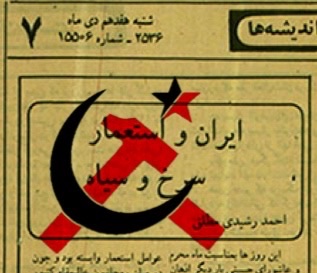
The Iranian Revolution stands as a haunting testament to the dangers of extremist ideologies, demanding a resolute response. The unholy alliance between leftist and Islamist groups in Iran , climaxing in a savage theocracy ruled by terrorists, underscores the urgent imperative to comprehend and combat radical movements steeped in both Islamism and Marxism.
The Alliance of Leftists and Islamists
The alliance between leftists and forces seeking to fragment Iran has a long history, spanning over 80 years. At the beginning of Mohammad Reza Shah’s reign, the Stalinist Tudeh communist Party in Iran, the main leftist intellectual organization, instigated significant uprisings in Azerbaijan and Mahabad under the leadership of Mr. Pishevari and Mr. Qazi (Ghazi) Muhammad.
Driven by the directives of Joseph Stalin and their Soviet masters, their goal was to annex these crucial regions to the Soviet Union through Soviet communism. This marked the first chapter in the book of betrayal against the homeland, occurring between 1945-1947, just a few years after the country had been liberated from Allied military occupation.
Their aim was to disrupt the young Shah’s government and undermine the country’s peace and stability at a time when Iran was still grappling with various political and economic crises.
Assassinations by the Tudeh Party and Islamist Fadaiyan-e-Islam (Islam Sacrificers)
After the failure of their separatist conspiracies, the Tudeh Party turned to political assassinations during Mohammad Reza Shah’s reign. In 1948, they attempted to assassinate the Shah himself while he was visiting Tehran University to commemorate its founding anniversary. The plot, executed in front of the Faculty of Law at Tehran University, aimed to kill the symbol of national unity, disrupt the country’s administration, and pave the way for Soviet influence in Iran. Although the conspirators failed on February 4, 1949, individuals nurtured by the same ideological factions, in alliance with the clerics, orchestrated a joint conspiracy in February 1979, resulting in 44 years of terror and destruction in the country.
After the failure of these schemes by the Stalinist Tudeh Party, the task of inciting violence and crisis was handed to a new group of terrorists known as “Fadaiyan-e-Islam.” This group began a fresh wave of assassinations and sabotage. In their first act of political terror, Abdul Hossein Hajir, the former Prime Minister, was assassinated by Fadaiyan Islam while attending a mosque in 1949. This highlighted the terrorists’ disregard for the sanctity of both the “house of God” and the house of justice.
Approximately a year later, another member of Fadaiyan Islam, Khalil Tahmasbi, assassinated Prime Minister Haj Ali Razmara in March 1951, making him the first sitting Prime Minister to be killed by saboteurs. This assassination dealt a significant blow to the country and its people. The close ties between Fadaiyan Islam and Abolqasem Kashani, along with the subsequent rise of the Mossadegh-Kashani coalition government immediately following this assassination, suggest that the “godfather of the National Front” might have colluded with the “Fadaiyan-e-Islam terrorists” in eliminating a political rival. In the third phase of their crisis-inducing policies, the Fadaiyan-e Islam attempted to assassinate Hossein Ala, the Prime Minister at the time, in November 1955. However, this assassination plot failed, leading to the arrest and execution of Navaab Safavi and other terrorists, which temporarily restored peace in the country.
Although political assassinations somewhat declined in the 1950s, the aftermath of the August 1953 coup weighed heavily on the country’s political horizon. Some political figures preferred to sacrifice national interests for factional and sectarian interests, spreading chaos and crisis in the country by standing against the constitution. A prime minister (Mossadegh) who claimed to be a man of the law was automatically dismissed from office due to the unconstitutional dissolution of the parliament that had previously voted confidence in him and his government. He chose to embark on a political adventure that not only imposed a major crisis (oil embargo) on the country but also delayed the Shah’s ambitious reform plans for a decade, a period that could have been transformative for the country but instead became entangled in political and social turmoil.
With the beginning of the 1940s and the Shah’s Revolution, the dark clouds that had overshadowed the country’s political scene gradually dissipated. Patriot technocrats emerged from the progressive movement, entering the Iranian political arena under the shadow of the constitutional monarchy, to guide the country towards development and progress.
However, Khomeini’s subversion on June 5, 1963, once again showed that the terrorists had returned hand in hand, revitalizing with a kind of resurgence to continue the politics of terror and sabotage. In their first act, just a year after the formation of the technocrat government, the united terrorists, known as the “Islamic Alliance,” assassinated Prime Minister Hassan-Ali Mansour in 1964, proving that they were ready to commit any crime to betray their homeland. This assassination made Mansour the second sitting Prime Minister and third political figure with a Prime Ministerial background to be killed during Mohammad Reza Shah’s 23-year reign, thwarting Iran’s progress and development plans. This assassination, aimed at obstructing Iran’s development and reform plans, backfired with the emergence of the powerful and capable government of Amir Abbas Hoveyda, and the country’s development continued. Modernization, rapid economic progress, and development plans that were underway throughout the country had led to a change in the strategy of saboteurs and terrorists. They shifted their focus towards eliminating the country’s economic figures, especially private sector owners. As a result, it didn’t take long for leftist armed organizations to be formed in the country, initiating their destructive actions with kidnappings and assassinations of merchants and entrepreneurs, actions they themselves admitted were aimed at preventing the people’s happiness and the country’s prosperity. Instead of contributing to the country’s progress and prosperity, these groups sought to undermine stability and development through violence and terror.
Despite the efforts of these terrorist organizations, Iran continued to progress under the leadership of Mohammad Reza Shah. His ambitious reform plans aimed to modernize the country and improve the lives of its citizens. However, these efforts were constantly challenged by leftist and Islamist groups who sought to create chaos and prevent progress.
Conclusion
The Iranian Revolution stands as a poignant example of the perils posed by extremist ideologies and the crucial need to confront them effectively. The historic collaboration between leftist terrorists and Islamist terrorists , culminating in a brutal theocratic regime governed by terrorists, highlights the pressing importance of understanding and addressing radical movements rooted in both Islamism and Marxism.
Recent protests on Ivy League campuses and the indoctrination of students with Marxist ideologies in higher education mirror the strategies employed by leftist terrorists in Iran. These events highlight the enduring relevance of the lessons learned from the Iranian Revolution.
The indoctrination of students with Marxist ideologies can create an environment conducive to radicalization, echoing the circumstances that precipitated the Iranian Revolution.
The Iranian Revolution serves as a stark reminder of the dangers of underestimating the resolve of extremist groups. The Shah’s failure to underestimate the threat posed by the alliance of leftist and antisemitic Islamist terrorists led to the establishment of a repressive regime that continues to oppress its populace.
In summary , the Iranian Revolution illuminates the dangers of extremist ideologies. The ongoing protests on US campuses , the rise of antisemitism, and the propagation of Marxist ideologies by academic circles highlight the necessity of remaining vigilant and effectively addressing radical movements. By drawing lessons from the Iranian revolution and identifying the hallmarks of radicalization, we can work towards fostering a more peaceful and tolerant society.
https://www.cia.gov/readingroom/docs/CIA-RDP82-00457R002400250002-0.pdf
https://history.state.gov/historicaldocuments/frus1951-54Iran/d19
https://history.state.gov/historicaldocuments/frus1964-68v22/d67
https://merip.org/1980/03/the-guerrilla-movement-in-iran-1963-1977/


Leave a Reply