Simone Derayeh
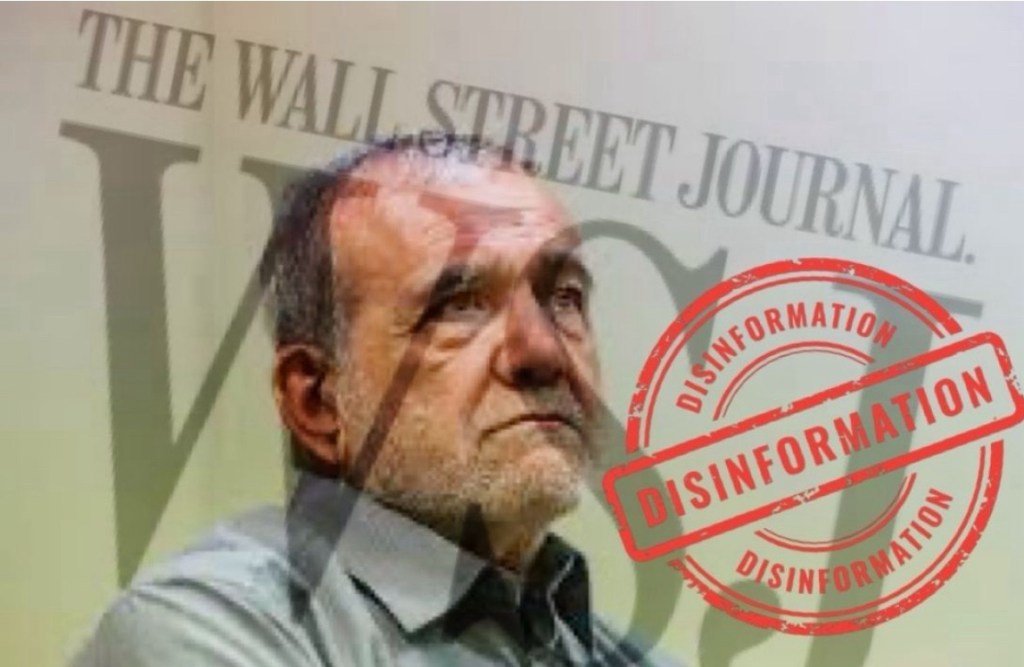
The Wall Street Journal’s (WSJ) recent video report on the election in Iran based on an article by Aresu Eqbali, contains several instances of disinformation and misleading narratives that obscure the political realities in Iran.
The report presents a distorted picture of the political situation in Iran. By omitting crucial context and perpetuating inaccuracies, it fails to provide a truthful account of the election and its broader implications. Accurate journalism is essential for informed public discourse, especially when covering complex international issues. It is imperative that media outlets strive to present a balanced and factual narrative to uphold the standards of responsible journalism.
Here is a list of inaccuracies and misrepresentations in the report:
False Claim of the First Reformist President in Two Decades
The report’s most significant falsehood is the assertion that Masoud Pezeshkian is the first reformist president in two decades. This is incorrect, as President Hassan Rouhani, a reformist, served two terms from 2013 to 2021, right before the previous president, Ebrahim Raisi, who was killed in a helicopter crash. This clear distortion of facts skews the WSJ viewer’s / reader’s understanding of Iran’s history and politics.
Misleading Representation of Election Participation
The video/article claims that Iranians elected Masoud Pezeshkian as their new president with more than 53% of the vote; this was reported by IR media which is known for false information. This narrative fails to mention the dismally low voter turnout, which was in fact about 10% based on calculations of unbiased mathematicians who reviewed the reported numbers. The election was widely regarded as a sham, with many Iranians boycotting the process in protest against the lack of genuine democratic choice. This critical context is omitted, giving the false impression of widespread popular support for Pezeshkian. Additionally, no background is given to explain the antidemocratic nature of these elections due to the process of preselection via the Guardian Council, a body of mostly clerics that chooses candidates based on their devotion to the supreme leader.
False Claims about Pezeshkian’s Political Stance
The report describes Pezeshkian as the first reformist president in “two decades”, ignoring the fact that President Hassan Rouhani, a reformist, held office for eight years before Ebrahim Raisi. This misinformation skews the viewer’s understanding of the Iranian political landscape and diminishes the complexities of factional politics within the Islamic Republic.
Pezeshkian’s Vow to Resume Negotiations with the U.S. and Abolish the Morality Police
The video/article mentions Pezeshkian’s intentions to negotiate with the U.S. to lift sanctions and his pledge to abolish the morality police. However, it fails to provide a comprehensive analysis of these promises. Notably, Pezeshkian was one of the first proponents of mandated hijab within the Islamic Republic, casting doubt on the sincerity and feasibility of his pledge to remove the morality police. Additionally as a physician he spoke fervently about banning of female patients being examined by male physician, proving further that he is no less fundamentalist when it comes to sharia laws. This contradiction is not explored, leaving viewers with an incomplete understanding of his political positions.
Ignoring the Severity of Economic Challenges and Public Discontent
While the report mentions Iran’s battered economy and disaffected population, it does not delve into the severity of these issues, such as systemic corruption and gross mismanagement. In fact based on the regime’s own data 65% of Iranians live below the poverty line. The narrative glosses over the public discontent and the widespread protests that have occurred over the past years, misleadingly suggesting that the election of Pezeshkian could bring significant positive change without addressing these underlying problems.
Claim of Softening Iran’s Image
The video/article claims that Pezeshkian’s election gives Iran’s leaders a way to soften their image as they fortify ties with Russia and China. This assertion oversimplifies the geopolitical dynamics at play. While Pezeshkian’s reformist label might superficially appear to soften Iran’s image as the article suggests, it ignores the strategic imperatives driving Islamic Republic’s foreign policy. The alliances with Russia and China are rooted in economic and security considerations that are unlikely to shift significantly based on the election of a new president. Pezeshkian’s agenda is more likely focused on negotiating with the U.S. to reincarnate the JCPOA in an effort to remove the sanctions which although not fully but help curb the Islamic Republic’s funding of the proxies such Hamas and Hezbollah. While the WSJ article’s claims about attempting to soften the image might appear correct, it fails to acknowledge the broader geopolitical strategies and motivations behind the Islamic Republic’s international relationships. Additionally the supreme leader, Khamenei, is the ultimate decider of all matters of state specially those related to foreign policy.
Mischaracterization of Protestors Outside Iran
The article describes the protestors outside Iran as solely monarchists. This is a falsehood, as the boycotters of the election included individuals from all sides of the opposition, ranging from left to right, including republicans. Although many protestors followed the leadership of Crown Prince Reza Pahlavi, they represented a diverse spectrum of political ideologies, not necessarily all monarchists, united in their opposition to the election process.
The WSJ’s reporting on this election reflects a troubling pattern seen in other major publications like The New York Times, where journalists with close ties to the Islamic regime in Iran have skewed narratives to paint a misleadingly favorable picture. Such journalistic malpractice is not only unexpected but deeply disappointing from a publication with the reputation of the WSJ. Accurate and responsible journalism is crucial for understanding international affairs, and media outlets have a duty to present a truthful account that respects the complexity of the issues at hand.


Leave a Reply