Penhan Tehrani
In the shadowy intersections of global philanthropy, regime politics, and geopolitical intrigue, few relationships are as perplexing as the one between the Islamic Republic of Iran and George Soros’s Open Society Foundation (OSF). What began in 2002 as a series of regime-approved humanitarian projects in Iran quickly evolved into a tangled web of suspicion, arrests, and accusations of foreign interference. This article reveals deeper questions about the role of foreign influence, soft powers, and the often-blurred lines between philanthropy and clandestine rapprochement.
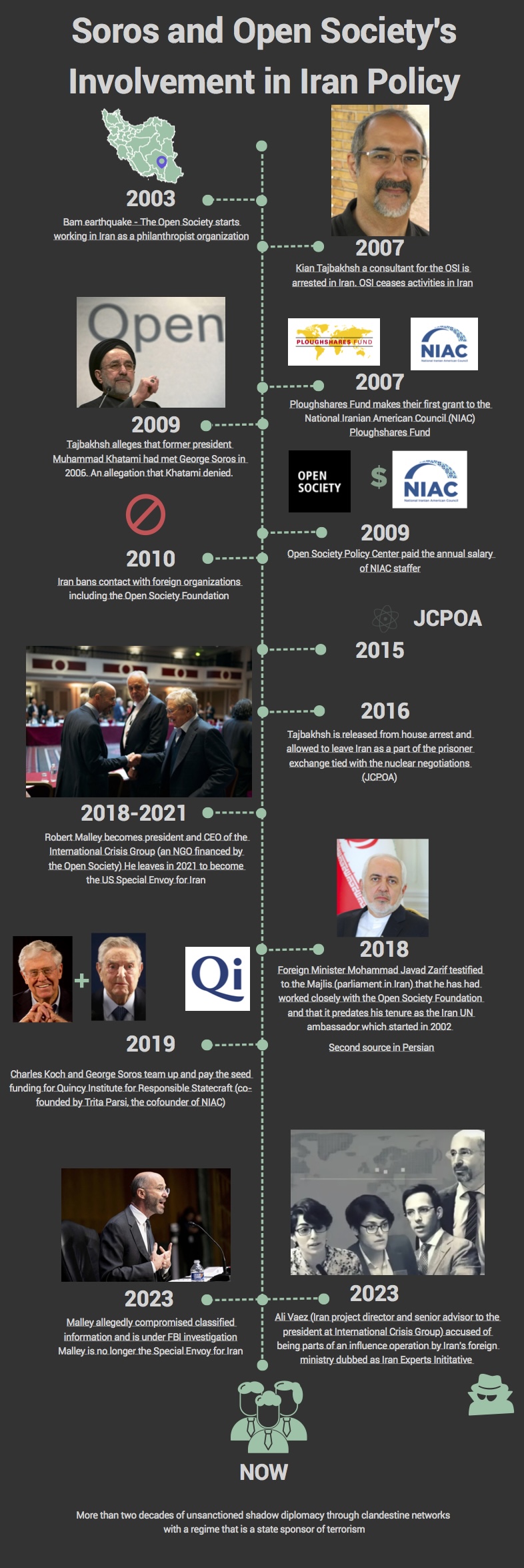
The relationship between the Islamic Republic of Iran and George Soros’s Open Society Foundation (OSF) first surfaced in 2002, when Kian Tajbakhsh, a World Bank employee, began working as a consultant for the foundation with the regime’s official approval.[1] Under this arrangement, OSF undertook various philanthropic initiatives, including addressing intravenous drug use and AIDS education, as well as providing relief efforts following the Bam earthquake, a moment when the foundation solidified its presence in Iran.[1][2]
In 2007, Kian Tajbakhsh was arrested and held in solitary confinement for several months before eventually being released on parole. Following his release, he severed ties with the Open Society Foundation (OSF)[2]. It is worth noting that by this time, OSF had already come under intense scrutiny for its involvement in Georgia’s 2003 Rose Revolution[3] and its alleged role in Ukraine’s Orange Revolution.[4][5]
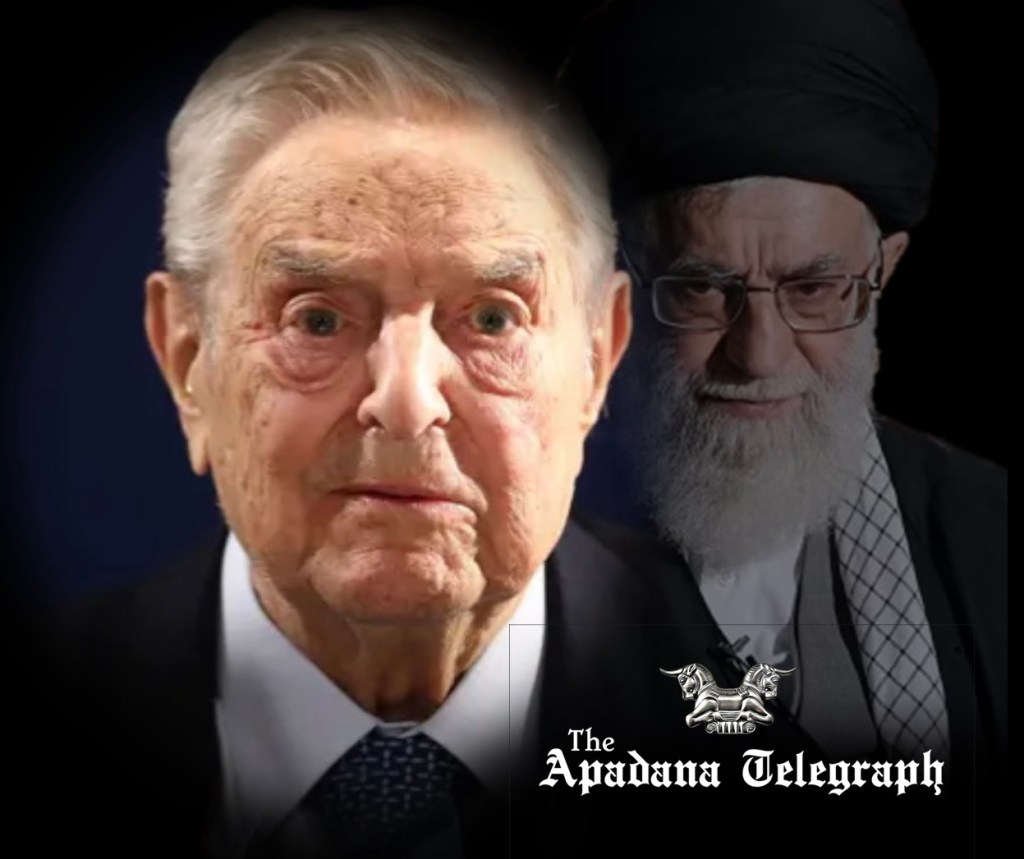
Iran’s Supreme Leader, Ali Khamenei, voiced his suspicions regarding Soros’s activities during a 2006 speech at Semnan University, where he alluded to Soros without directly naming him. His comments reflected the regime’s growing unease about foreign influence, particularly through organizations like OSF.
In Georgia, there was a regime change and a Jewish American zionist financier – Who is famous and I don’t want to bring his name – mentioned that he has spent 10 million dollars to cause the revolution; quite simply. They spend 10 million dollars to exchange a government with another. That is why they influence the people and organize societies. They did it in Ukraine too; and other places.[5]
Following the rise of the Green Movement, Tajbakhsh was once again arrested, this time accused of threatening national security. During his detention, he confessed that Mohammad Javad Zarif and former president Mohammad Khatami had met George Soros in New York in 2006. However, this claim should be viewed with skepticism, as forced and fabricated confessions are common tactics used by the Islamic Republic’s judicial system.[6] This raises questions about the legitimacy of such accusations, particularly in the politically charged environment that followed the Green Movement’s protests.
In 2006, the Open Society Foundation (OSF) made a $50,000 donation to the National Iranian American Council (NIAC), an organization widely believed to function as a pro-Tehran lobby[7][8]. Further fueling these suspicions, a 2009 Politico article revealed that a staffer at NIAC, who led the “Campaign for a New Policy on Iran,” was receiving their salary through the Open Society Policy Center[9]. These revelations have only deepened concerns about the OSF’s financial ties and potential influence over policy advocacy related to Iran in the US.
Many recipients of Open Society Foundation (OSF) donations, as well as those funded by the Ploughshares Fund — an organization receiving over $100,000 annually from OSF—were vocal advocates for the Joint Comprehensive Plan of Action (JCPOA). This group included prominent NIAC staffers and controversial figures such as Ali Vaez, Trita Parsi, and Seyed Hossein Mousavian. By strategically leveraging friendly media outlets and deploying an “echo chamber” approach, as described by Ben Rhodes, these advocates played a key role in securing the passage of the JCPOA in 2015[10]. This tactic highlights how coordinated messaging can influence public perception and policy outcomes in complex international negotiations.
Among the stipulations of the JCPOA was a hostage release deal, which included the release of $400 million to the Iranian regime[11][12]. While the agreement secured the freedom of four high-profile Americans, including Jason Rezaian, The New York Times reported that Kian Tajbakhsh and another American, Matthew Trevithick, were released through a separate arrangement. According to the report, “And two other American detainees, Kian Tajbakhsh and Matthew Trevithick, quietly left on commercial flights, in an arrangement officially classed as separate from the larger package”[12], This distinction underscores the complexity and layered nature of negotiations tied to the JCPOA and its media coverage.
Soros also founded the International Crisis Group (ICG), an organization that receives partial funding from the Open Society Foundation (OSF). In 2018, Robert Malley, the former Special Iran Envoy who has been under FBI investigation since 2023, was appointed president of the ICG[13]. Notably, reports surfaced that at least three of Malley’s close associates had connections to Iran’s foreign ministry[14][15]. This development adds another layer to the complex narrative of Soros’s global influence, raising deeper questions about the potential links between foreign advocacy groups and the Islamic Republic.
During a 2018 questioning session, then-Foreign Minister Mohammad Javad Zarif acknowledged that the Iranian regime had been working closely with the Open Society Foundation (OSF). He further stated that this relationship had been established prior to his arrival in New York in mid-2002[16][17]. Zarif’s admission sheds light on the longstanding, yet often concealed, ties between the regime and Soros’s organization, raising important questions about the nature of foreign influence and collaboration in Iran.
In 2019, reports revealed that Trita Parsi, co-founder and president of the National Iranian American Council (NIAC), secured $500,000 in seed funding from George Soros and Charles Koch to establish the Quincy Institute for Responsible Statecraft. Parsi serves as the executive vice president while Lora Lumpe who formerly worked for OSF as the advocacy director is the president. This organization has also been noted for promoting narratives sympathetic to Tehran, further complicating the discourse surrounding U.S.-Iran relations.
Soros’s influence as a prominent election donor and his extensive control over media channels cannot be denied[19]. His $32 billion venture has significantly shifted the landscape of global politics, enabling him to either instigate or prevent regime changes. Soros advocates for building organizations rather than pursuing revolutions, hoping for soft transitions in governance[20]. However, empirical evidence suggests that this approach is ineffective when dealing with totalitarian theocratic regimes, such as the one in Iran. It is time for George Soros and his son to abandon their roles as “democracy-building” superheros and stop imposing their neo-colonialist and idealistic visions of democracy on societies whose complexities they fail to understand. This misguided approach only prolongs the suffering of individuals living under brutal dictatorships, exacerbating their struggles rather than alleviating them. It is also time for politicians to put an end to the foreign-favored influences that shape U.S. politics. This practice undermines the integrity of our political system and prioritizes the interests of foreign entities, in this case adversaries, over the needs and voices of American citizens.
References
- Azimi, Negar. “Hard Realities of Soft Power.” The New York Times, The New York Times, 24 June 2007, https://nytimes.com/2007/06/24/magazine/24ngo-t.html.
- “Statement on OSI Activities in Iran.” Open Society Foundations, https://opensocietyfoundations.org/newsroom/statement-osi-activities-iran.
- Fairbanks, Charles (2004). “Georgia’s Rose Revolution”. Journal of Democracy. 2. 15 (2): 113. doi:10.1353/jod.2004.0025. S2CID 144288404.
- https://css.ethz.ch/en/services/digital-library/articles/article.html/119208
- Khamenei.ir. “بیانات در دیدار دانشگاهیان سمنان.” صفحه اصلی, https://farsi.khamenei.ir/speech-content?id=3362.
- Khatami slams trial confessions – The Himalayan Times, https://thehimalayantimes.com/world/khatami-slams-trial-confessions.
- Joffe, Alexander H, and Gerald Steinberg. Bad Investment: The Philanthropy of George Soros and the Arab-Israeli Conflict. NGO Monitor, NGO Monitor, https://www.ngo-monitor.org/soros.pdf.
- https://web.archive.org/web/20210120191916/https://petitions.trumpwhitehouse.archives.gov/petition/niac-does-not-represent-we-iranians
- Documents Detail Iran Engagement Campaign – Politico, https://politico.com/blogs/ben-smith/2009/11/documents-detail-iran-engagement-campaign-022798.
- Samuels, David. “The Aspiring Novelist Who Became Obama’s Foreign-Policy Guru.” The New York Times, The New York Times, 5 May 2016, https://nytimes.com/2016/05/08/magazine/the-aspiring-novelist-who-became-obamas-foreign-policy-guru.html.
- Secor, Laura. “Her Husband Was a Princeton Graduate Student. Then He Was Taken Prisoner in Iran.” The New York Times, The New York Times, 10 July 2018, https://nytimes.com/2018/07/10/magazine/american-civilian-hostages-in-iran.html.
- Labott, Elise, et al. “US Sent Plane with $400 Million in Cash to Iran | CNN Politics.” CNN, Cable News Network, 4 Aug. 2016, https://cnn.com/2016/08/03/politics/us-sends-plane-iran-400-million-cash/index.html.
- FBI Probes Whether Iran Envoy Malley Committed Crimes in Handling of Classified Info – Politico, https://politico.com/news/2024/05/10/fbi-probes-iran-envoy-malley-classified-info-00157321.
- Solomon, Jay. “Inside Iran’s Influence Operation.” Semafor, 29 Sept. 2023, https://semafor.com/article/09/25/2023/inside-irans-influence-operation.
- Inside Tehran’s Soft War, https://content.iranintl.com/en/investigates/inside-tehran-softwar/index.html.
- Hamdeli News https://pishkhan.com/news/105161 24 Aug. 2018
- Iran Admits to Having ‘Worked Closely’ with George Soros Network – Jns.Org, https://jns.org/iran-admits-to-having-worked-closely-with-george-soros-network/.
- Charles Koch and George Soros Teamed up on a New …, https://washingtonpost.com/outlook/2019/07/11/some-questions-about-quincy-institute/.
- “George Soros: Media Mogul.” Media Research Center, https://mrc.org/george-soros-media-mogul.
- Rfe/rl. “World: Soros Says Revolutions Don’t Build Democracies.” RadioFreeEurope/RadioLiberty, RFE/RL, 2 Feb. 2012, https://rferl.org/a/1076135.html.
 The Apadana Telegraph
Leave a comment